Posts

Blog #6 - Visual

Image
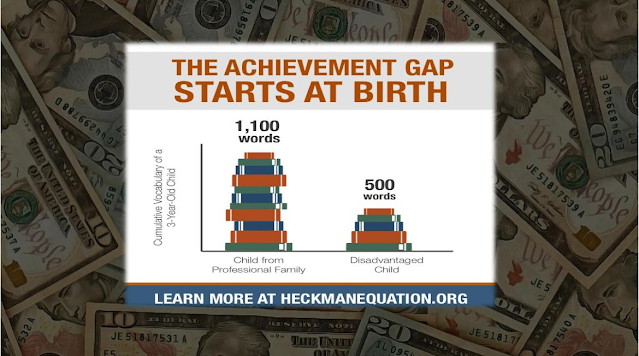
  This image shows how the achievement gap starts at birth, college students from disadvantaged families perform less well than high-income students on most measures of academic success including standardized test scores, grades, high school completion rates, and college enrollment, completion rates as well as lacking communication skills.

Blog Post #5

Research Question: How can the gap between high- and low-income group students in college affect their professional careers? What role does the government need to play in covering the tuition costs for the students from the low-income groups? Do merit-based admissions affects low-income students? What can be done in order to decrease the staggering cost of college that’s weeding out students who are disproportionately low-income? If the widening college completion gap fracturing the American Dream and its economy then why the government and policymakers aren’t doing anything to fix it? Sources: Brint, Steven. “Can We Fix the College Inequality Problem?” The American Prospect , 10 Dec. 2019, prospect.org/culture/can-we-fix-the-college-inequality-problem/.  Cabrera, ByJeff. “Poverty And The College Completion Crisis.” GenBiz , 13 Aug. 2018, genbiz.com/poverty-and-the-college-completion-crisis.  Center, NSC Research. “High School Benchmarks - 2019.” National Student Clearinghouse...

Literature Review #3

Image
  About the Author:  Sean F. Reardon is an American sociologist who currently serves as the Endowed Professor of Poverty and Inequality in Education at the Stanford Graduate School of Education, where he also is a member of the Steering Committee of the Center for Education Policy Analysis. Citations:  Reardon, Sean F. “The Widening Income Achievement Gap.” Educational Leadership , vol. 70, no. 8, May 2013, pp. 10–16. EBSCOhost , search.ebscohost.com/login.aspx?direct=true&db=eric&AN=EJ1029019&site=ehost-live. Summary of the Article: Sean F. Reardon conducted a comprehensive analysis of research to answer these questions and came up with some striking findings. In this article, he shows that income-related achievement gaps have grown significantly over the last three decades, even as black-white achievement gaps have closed. These gaps are already large when children enter kindergarten; in fact, they do not grow substantially during the school years. Gaps bet...

Literature Review #2

Image
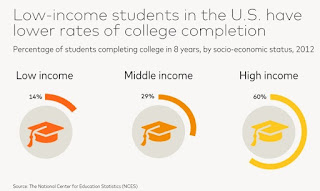
  About the Author:  Alanna Bjorklund-Young - Graduated with a Ph.D. in Economics in the year 2017 and has taught in 4 schools for about 1-2 year/years each. Won awards for undergraduate teaching. Currently, she is working as an assistant professor at Johns Hopkins University School of Education. Additionally, she has written several papers that investigate the impact of teaching skills on student academic and non-academic outcomes and is interested in the impact of education policy on student outcomes. Citations:  Bjorklund-Young, Alanna. "Family income and the college completion gap." (2016). Summary of the Article: This article has the latest research released in 2015 confirms that low-socioeconomic status (SES) students were less likely to complete their college education. After graduating high school, only 14 percent of low-SES students received a bachelor’s or higher degree within eight years compared to 29 percent of middle-income students. Furthermore, it talks a...

Blog #4

  Richa Patel Professor Goeller Research in Disciplines: College February 26, 2021 Working title: College completion gap between high and low-income students Topic          The topic that has been chosen for this proposal is to assess the contribution of financial aids on the academic establishment of the students from low-income groups. This is a very significant topic among the educational sector since low-income students lack the affordability towards availing the courses. They can attend part-time courses, which is not a permanent solution, as they drop these courses for their financial conditions. This situation has to be changed at any cost because this gap will determine the rates of unemployment in the country ( Bjorklund-Young: 24). This gap has to be reduced to promote income equality and better employability among youth throughout all communities whether their income is high or low. Proper investigations are needed in terms of a...

Literature Review #1

Image
  About the Author:   Elizabeth Mann Levesque earned her B.A. and Ph.D. in political science at the University of Michigan. Later, as a fellow at the Brown Center on Education Policy at the Brookings Institution, she studied a wide range of education policy issues, including civics education, employer and community college workforce development partnerships, and federal regulations related to the Every Student Succeeds Act . Elizabeth is currently a Nonresident Fellow at the Brookings Institution and an Instructional Consultant for the Foundational Course Initiative at the University of Michigan’s Center for Research on Learning and Teaching Citations: Levesque, Elizabeth Mann. “Improving Community College Completion Rates by Addressing Structural and Motivational Barriers.” Brookings , Brookings, 22 Oct. 2018, www.brookings.edu/research/community-college-completion-rates-structural-and-motivational-barriers/.  Summary of the Article The article discusses how many commun...

Blog #3

Image
Research Question: In the past few decades college admissions and graduation rates have lessened dramatically among lower-income students. Overall (U.S.) education spending has been cut off quite severely in the last few years. Is the government itself is responsible for generating achievement gaps? This topic is up for debate but why there isn’t a solution to this issue? will low-income students and their families remain in the low-income bracket? Resources : Michael Mitchell, et al. “State Higher Education Funding Cuts Have Pushed Costs to Students, Worsened Inequality.” Center on Budget and Policy Priorities , 24 Oct. 2019, www.cbpp.org/research/state-budget-and-tax/state-higher-education-funding-cuts-have-pushed-costs-to-students.  Carmel Martin, Ulrich Boser. “A Quality Approach to School Funding.” Center for American Progress , www.americanprogress.org/issues/education-k-12/reports/2018/11/13/460397/quality-approach-school-funding/.  Dan, Is there a relationship between ...